




Simon Kim On COTE, Coqodaq and Scaling Korean Luxury Dining
Gracious Hospitality founder Simon Kim reflects on leadership, longevity and the evolution of modern hospitality. Gary He
This Q&A is part of Observer’s Expert Insights series, where industry leaders, innovators and strategists distill years of experience into direct, practical takeaways and deliver clarity on the issues shaping their industries. Simon Kim has never treated Korean cuisine as a trend to be exploited. From the beginning, he approached it as a category to be built—carefully, rigorously and with long-term conviction. Since opening Cote in New York in 2017, Kim has transformed the idea of a Korean steakhouse into a scalable luxury format, one that now spans New York, Miami, Las Vegas and Singapore while maintaining Michelin-level consistency across radically different markets.
That consistency, Kim argues, is not the product of rigid replication but of clarity. COTE is deliberately linear at its core: a beef-centered Korean steakhouse designed and executed by subject-matter experts. The fundamentals do not change, even as each city brings its own cultural expectations. Rather than compromising standards to grow, Kim has built growth around people, developing leaders capable of executing at the highest level, wherever the restaurant opens. Expansion, in this model, is less about chasing opportunity and more about recognizing readiness.
As Korean culture becomes a global economic force—from food to fashion to entertainment—Kim sees hospitality entering a new phase of maturity. Broad, generalized notions of “Korean food” are giving way to more precise, regional and identity-driven expressions, similar to the evolution Italian and Japanese cuisines underwent decades earlier. COTE reflects Kim’s own lived experience as a Korean American trained in French fine dining: not a replica of a restaurant in Korea, but a New York restaurant that honors Korean culture while speaking fluently to its surroundings.
That balance between authenticity and adaptability, discipline and creativity extends to how Kim thinks about design, economics and risk. Dining, for him, is theater, not something to be over-quantified. Growth follows the logic of a living system. And success, ultimately, is measured by delight: if guests are genuinely moved by the experience, the business fundamentals tend to follow. In an industry defined by thin margins, investor pressure, and global competition, Kim’s approach offers a rare case study in how cultural relevance, operational rigor and creative conviction can coexist—and scale.
 As COTE expands from New York to Singapore and Las Vegas, Kim’s approach to hospitality emphasizes discipline, intuition and the quiet work of sustaining excellence. Gary He
COTE now operates in New York, Miami, Las Vegas and Singapore. What is the operating system that allows you to maintain Michelin-level consistency across such different markets?
It ultimately comes down to people and focus. We build and invest in creating exceptional teams of people who are not only incredibly talented but who are dedicated to our restaurants and brand. Rather than compromising standards to scale, we scale by developing leaders who can execute at the highest level in any market.
Equally important, COTE is a linear concept. At its core, it is a beef-centered Korean steakhouse built by subject matter experts. While each city brings different expectations, the fundamentals never change. By staying clear about what the experience is meant to be, we are able to maintain Michelin-level consistency across every location.
When you’re evaluating a new location, what metrics or signals matter most? Is it real estate, demographic data, tourism flows and local labor markets?
While we evaluate traditional metrics like real estate, demographic data, tourism flows and local labor markets, the most important factor is intuition. As a restaurateur, you have to feel whether the concept, the ethos and what we stand for genuinely fit into the zeitgeist of the city. That alignment is difficult to quantify, but it is critical. If the concept truly belongs in that moment and place, the metrics can almost always be made to work. But if it does not resonate with the city, no amount of data, analysis or strong numbers on paper will make it successful.
Korean culture has become a global economic engine, from food to fashion to entertainment. What do you see as the next frontier for Korean hospitality on the world stage, and how is your group positioning itself within that movement?
Korean hospitality is entering a similar evolution to what we have already seen with Italian and Japanese cuisine. Those cuisines first became global through broadly defined concepts, like red sauce Italian restaurants or generalized Japanese restaurants, before moving into much more regional and localized restaurants. Korean food is now at the next phase, where it will no longer be enough to say something is a Korean restaurant. We are going to see clearer segmentation, whether that is food rooted in a southern port city like Busan or other distinct regional identities, much in the same way people understand northern versus southern Italian cuisine.
At Gracious Hospitality Management, our role is to stay true to who we are while helping move that evolution forward. I am Korean and American, and COTE reflects that identity. We are not a replica of a restaurant in Korea. We are a New York restaurant that embodies New York sensibility while honoring Korean culture. This makes us well placed to act as a bridge or a guide for authentic Korean concepts entering the U.S. market. Whether that means facilitating, funding, consulting or helping Korean hospitality brands translate their vision for an American audience while staying true to their roots. We see ourselves as a sherpa in that journey, helping the next generation of Korean hospitality find its place on the global stage.
 Dishes at COTE reflect a balance of tradition and modern technique. Gary He
As Korean cuisine becomes more globalized, how do you navigate the tension between cultural authenticity and the expectations of an international audience?
Cultural authenticity is immensely important, but for us, what matters even more is our own authenticity. We are a Korean steakhouse, but we never set out to be the greatest replica of a Korean restaurant in America or to mirror what already exists in Korea. From the beginning, the goal was to be true to ourselves. I am Korean American and trained in French fine dining, and COTE reflects that lived experience. Staying true to that core has always been our priority.
I also believe the future of Korean culture and restaurants in the U.S. is incredibly bright. I imagine it like a coral reef, with casual places, fine dining restaurants and street food. I think it’s instrumental in supporting that diversity to create a robust and vibrant community for Korean cuisine. For Gracious Hospitality, our responsibility is to remain anchored to who we are. Our north star lives within us, and that is what guides everything we do.
COTE’s expansion has been unusually disciplined compared to many fast-scaling restaurant groups. What operational philosophy or economic principle has most shaped the way you decide when—and where—to grow?
Our approach to growth is no different than a plant. When you have a tree that’s growing, you don’t repot it just because you want more plants. You repot it when it has outgrown its pot. That’s what dictates us. Growth happens when the timing is right, not simply based on desire.
For us, people are the most important factor. When our team members have outgrown their current opportunities and are ready for more responsibility, that signals it’s time to grow and ensure that our people have the capacity to do so. The same mindset applies to Gracious Hospitality Management. We cannot just open restaurants; we need the corporate infrastructure to support the growth of the brand, whether that is quality control, purchasing, marketing, HR or accounting. These systems take time to grow, and if we push too fast, there are inevitable growing pains. While we are growing rapidly, we are extremely disciplined because we care. We have an unspoken promise to deliver the highest quality Korean steakhouse experience, and that is the brand we are building. That is what our customers always expect, which requires being incredibly strategic about everything we do. Even though I may look risk-forward, I am actually very risk-averse, and that discipline allows us to protect the quality and integrity of the experience.
 At a moment when Korean culture has become a global economic force—from entertainment and fashion to food—Kim sits at the intersection of creativity and systems-building. Michael Kleinberg for Rockwell Group
Your concepts each have highly defined identities. What systems or structures have you built to scale without diluting the creative DNA that made COTE successful in the first place?
We work incredibly hard to ensure that expansion of our brand does not dilute the creativity or experience. It’s similar to the experience of making Kool-Aid. If you have Kool-Aid and you pour in more water, it’s going to be diluted. If you don’t want that to happen, you need to add more Kool-Aid. There is a formula here. As we expand, the flavor needs to become more intensified, not diluted, which means we have to focus even more on the creative process. It is not an easy process to maintain both quality and creativity, but it has been incredibly important for us to put processes in place that allow us to continue focusing on creativity while maintaining the same high-quality experience from an operations perspective.
One example is the development of a new R&D department that allows our teams to evolve and explore new ideas. Each restaurant needs to be creative yet unified. When I open a new location in a new market, around 80 percent of the menu is completely unified, while 20 percent allows for autonomy. While we’re immensely grateful for our success and the support we’ve been given, we’re still a young company, continuously trying to evolve and push the creative limits.
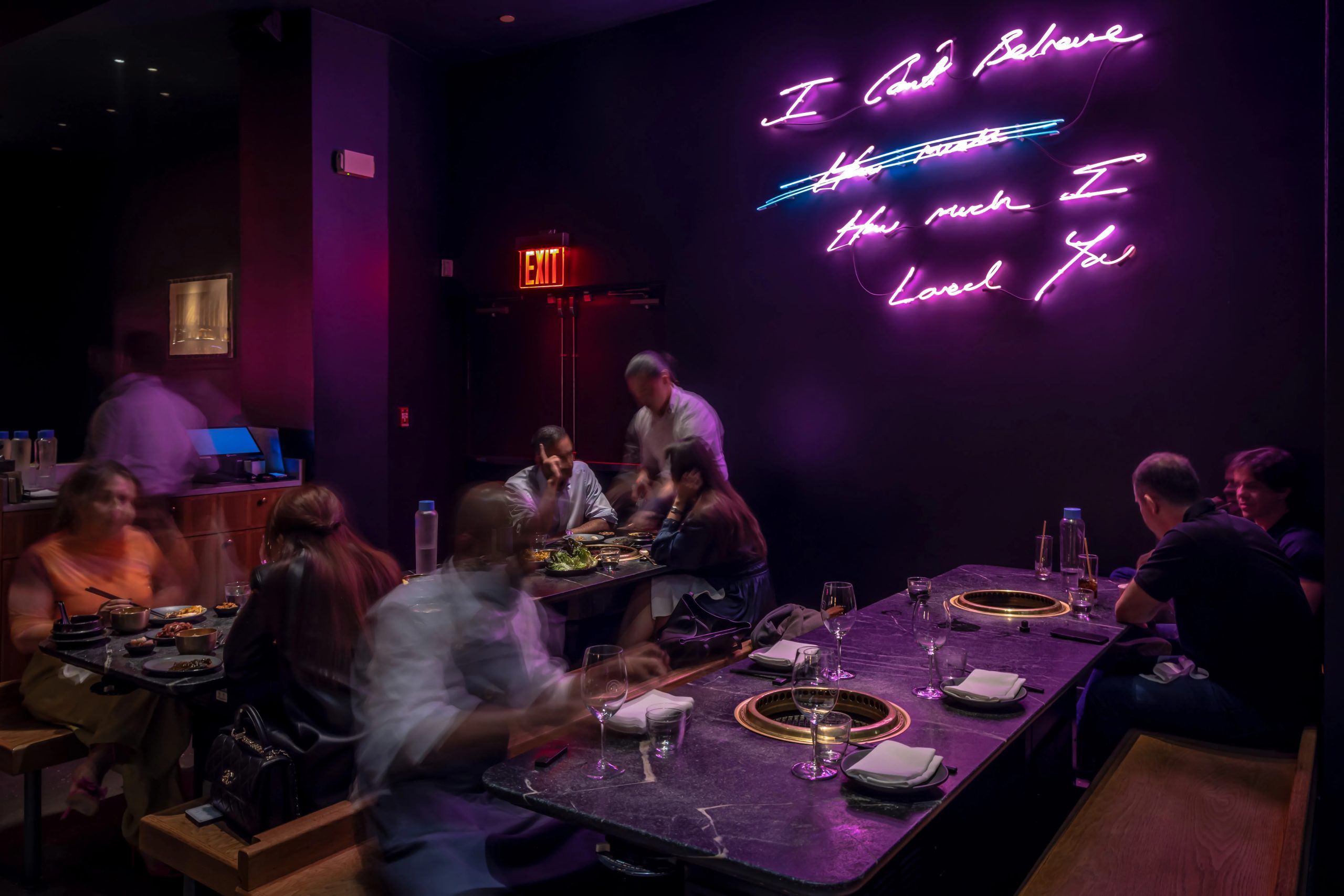
You’ve said dining should feel like theater. How do you quantify the returns of design—lighting, acoustics, materials, the “spectacle factor”?
Magic should not be over-analyzed. We do not quantify it. We are very fortunate that our restaurants are popular and turn in healthy profits, and we are incredibly grateful for the support we’ve been given. To me, the elements that make dining whimsical, ethereal and theatrical are what make it memorable. We do not try to over-analyze these things. One of the biggest secrets about magic is not asking for the secrets.
 By merging Korean culinary heritage with the rigor of French fine dining and the theatricality of New York hospitality, Kim transformed Korean barbecue into a Michelin-starred luxury format that has proven replicable across markets like Las Vegas, Miami and Singapore. Gary He
You’ve built multiple Michelin-starred concepts. Is the Michelin system still aligned with the realities of modern dining, or is a new model emerging?
The Michelin Guide has always been, and in my opinion, always will be, the standard for culinary and gastronomical experiences in the world. While the industry has changed as a whole, there is no other entity that holds the same weight and respect. The guide has been extremely responsible, and it remains the most reputable and objective authority. To me, it will always be the standard.
Hospitality is increasingly shaped by real estate economics, investor expectations and global brand competition. How do you make decisions in an environment where cultural relevance, financial discipline and creative risk all compete for priority?
I am a restaurateur before I am a businessman, and that perspective is very important. There is a reason why big corporations sometimes struggle to run successful restaurants. Analysis paralysis is real. What I’ve learned is that finding the right team is the most important factor in building corporate infrastructure. Once you have a finance team and accountability in place, you can focus on delighting customers.
All of the other factors are extremely important, but the guiding principle is whether you are able to delight your customers. If you can do that, the business volume will follow, and you will have the runway to figure everything else out with the right team. Ultimately, my first goal is always to bring delight to our customers.
The restaurant industry is notorious for thin margins. What is some advice you believe the next generation of hospitality leaders will need to adopt to stay competitive?
When I was starting out in the industry, it felt impossible to compete with all of the big-name chefs and restaurants. What I lacked in notoriety, I had in grit, agility and the ability to be creative. My advice for the generation would be to focus on the unique element that makes you one of a kind. Focus on what the older generation may not fully understand, whether that is A.I., technology or the desires and habits of younger diners. Leveraging those insights while understanding traditional approaches will allow them to create a competitive and compelling business venture.
 Since opening COTE New York in 2017, Kim has built something rare in modern dining: a concept that honors cultural tradition while scaling with discipline, precision and creative confidence. Gary He
You’ve hinted at QSR-style spin-offs and new concepts coming to 550 Madison. What white spaces in hospitality still feel underserved?
There is so much opportunity, especially in the clean-label space. Personally, I am in the food business, and I do not want to serve anything that is not delicious. How you feel after eating is just as important as how you feel before or during. Whether it is QSR, sit-down restaurants or CPG, clean-label options remain underserved.
Our mission at Gracious Hospitality is to delight our customers. I mean that not just in taste but also in health and how they feel. We focus on that, and we want to continue expanding across all facets to fulfill our mission of bringing more delight to our customers.
550 Madison will be your largest project to date—a multi-concept landmark occupying one of New York’s most iconic buildings. What does a project of this scale allow you to attempt creatively or operationally that wasn’t possible in your earlier restaurants?
It’s a true honor to create at 550 Madison. In my opinion, it is one of the most important pieces of real estate in New York City. It’s such a historic building, and one that I feel immense pride and honor to be a part of. 550 Madison is something we’ve never done before. It’s a brand new space, which creates an opportunity to bring something fresh and new while respecting tradition. It is a great canvas to create something that feels connected to New York’s past and present while also embracing the future.
This project allows us to attempt things creatively and operationally that weren’t possible in earlier restaurants. With this opening, we’re able to bring together multiple concepts under one roof and collaborate with extraordinary partners like David Rockwell, Chef Yoshitake and the Olayan Group. Each of them is a master in their own craft, and this will be a true opportunity to combine everyone’s experience, history and expertise to create something greater than the sum of its parts. As David Rockwell says, it takes a village. Everyone involved understands the magnitude of this project.
This is not about bringing downtown to midtown. It is about opening the next chapter of what midtown dining can be, while honoring the legacy of the past. I am extremely optimistic that the best of New York City’s dining scene is yet to come, and this is a very important mission that we do not take lightly. I am deeply honored to carry the torch and excited to bring together these creative perspectives to build something innovative, deeply connected to New York and reflective of the energy and vibrancy of the city’s future.