





Who Picks the Next Fed Chairman?
Why Trump Will Pick the Next Fed Chair, With or Without the Senate
Jerome Powell’s decision to publicly attack the Trump administration could give President Trump the opportunity to appoint a leader of the Federal Reserve without Senate approval.
As everyone knows by now, Fed chair Powell took the unprecedented step on Sunday night of posting a video accusing the Trump administration of attempting to undermine the independence of the Federal Reserve. He said, without offering any evidence, that the Justice Department’s inquiries into his Senate testimony and the renovations of the Fed’s headquarters were “pretexts” for attacking the Fed because it has not cut interest rates enough to satisfy the president.
That allegation has not been substantiated and looks very doubtful. President Trump immediately denied that he had anything to do with the subpoenas. U.S. Attorney for the District of Columbia Jeanine Pirro, whose office issued the subpoenas, responded to Powell’s claims by explaining that her office’s attempts to contact the Fed by the Attorney’s Office had been “ignored” and that this is why federal prosecutors resorted to ordering the Fed to respond. She said the subpoenas were “not a threat.”
“The word ‘indictment’ has come out of Mr. Powell’s mouth, no one else’s. None of this would have happened if they had just responded to our outreach,” Pirro said.
The timing of Powell’s announcement appears to have been aimed at catching the Trump administration off guard and achieving as much financial disruption as possible. If that was the Fed chair’s aim, it appears to have failed. Stocks closed up on the day, and the bond market did not show any signs of an investor panic.
Senators Fantasize They Can Block Trump from Appointing Powell’s Successor
As calmly as the markets took the news that the Department of Justice had served the Fed with subpoenas, the political and media establishment went into a full-scale meltdown. Senators Tom Tillis (R-NC) and Lisa Murkowski (R-AK) said that they would not vote for Trump nominees to the Fed until the issue of the Justice Department’s investigation is resolved. With the Republicans holding on to a razor thin majority in the Senate, this would likely mean that Trump would not be able to get his nominee to succeed Powell confirmed.
So, what happens if Powell’s term ends and there is no confirmed Fed chair waiting to take over? Tillis and Murkowski appear not to have thought this through. Perhaps they think that Powell can remain chair in defiance of President Trump or that the leadership of the Fed would fall to Phillip Jefferson, the Biden appointee who is now vice chair of the Fed’s board of governors. If so, they are very likely mistaken.
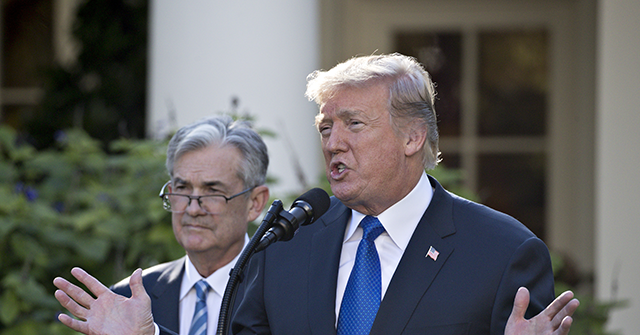
President Donald Trump speaks as Federal Reserve Chair nominee Jerome Powell listens in the White House Rose Garden on November 2, 2017. (Andrew Harrer/Bloomberg via Getty Images)
The Federal Reserve Act provides that when a Fed governor’s term expires, the officeholder can remain in place until a successor is confirmed. This does not apply, however, to the chair of the Fed. When the term of the chair expires, he is no longer the chair unless nominated by the president and confirmed by the Senate. If his term as governor has not expired—governors get 14-year terms and chairman just four—he can remain on the board but not as chairman. Because this would likely undermine the authority of the next chairman, however, the unbroken precedent for decades has been that chairs resign their governorship when or shortly after their chair term concludes.
There is a provision of the Federal Reserve Act that says the vice chair takes the reins in the “absence” of the chair. It goes on to say that if the vice chair is also absent, the board of governors can elect a chairman pro tempore. But this probably does not apply to the situation that arises when a Fed chair’s term reaches its end and no new chair has been confirmed.
The Arthur Burns Precedent
Lawyers for the Carter administration looked into this in 1978. Arthur Burns, who had been appointed Fed chairman by Richard Nixon in 1970, was a frequent critic of Jimmy Carter’s economic policies. Despite inflation running around seven percent in Carter’s first year in office and showing no signs of cooling, the Carter administration objected to the Fed’s tightening of the money supply. But many assumed that Carter would not oust Burns, who wanted to stay on as Fed chair, when his term ended in January of 1978.
That assumption turned out to be wrong. After Vice President Walter Mondale, Treasury Secretary Michael Blumenthal, and liberal advisers to Carter pushed the president to bring in someone new, Carter unexpectedly announced at the end of December that he was replacing Arthur Burns as Fed chair with New England industrialist G. William Miller. The problem was that this didn’t leave enough time for the Senate to confirm Miller before Burns’ term expired. The Office of Legal Counsel determined that the best legal interpretation of the Federal Reserve Act was that “absence” only referred to a chairman who was temporarily unavailable due to travel or illness. It did not apply to a vacancy, the counsel to President Carter advised. In fact, there is no explicit provision covering what happens in the case of a vacancy.
In the absence of a statutory scheme for covering a vacancy, the “President possesses inherent authority to make temporary appointments necessary to ensure the continuing operation of the Executive branch,” Deputy Assistant Attorney General Larry Hammon wrote in a memo to Carter. In other words, if the Fed chair’s term ends (or if a Fed chair were to die) and no one has been confirmed to succeed him, the president would appoint one of the governors as acting chair.
“Because of his limited term, the present Chairman may not hold over in office and continue to perform his official functions. In light of the specific statutory limitation concerning service during the Chairman’s ‘absence ‘ the better view is that the Vice Chairman may not, under his statutory authority, automatically serve as Chairman during a temporary vacancy in the office of the Chairman. In the absence of any statutorily prescribed mechanism for filling vacancies, the President may designate one of the members of the Board to serve as acting Chairman until such time as the nominee has been confirmed,” Hammond concluded.
Even more unexpectedly, President Carter decided to appoint Burns as acting chair until Miller was confirmed, and Burns served in this capacity from the start of February through Miller’s confirmation on March 8. This appointment was accomplished through an explicit presidential order. It was not something that happened automatically. Carter even went so far as to invite Burns to stay on as governor until his term expired in January 1984. Burns turned Carter down.
Arthur Burns (left), outgoing chairman of the Federal Reserve, and U.S. President Jimmy Carter share a laugh in the White House press room on December 28, 1977. (UPI/Bettmann Archive/Getty Images)
“I have given careful thought to the question of continuing to serve as a member of the Federal Reserve Board and have decided not to do so. This decision is based on my conviction that Mr. Miller deserves the fullest opportunity to establish his leadership at the helm of our Nation’s central bank. The continued presence of a former Chairman could, in my judgment, be a complicating distraction,” Burns wrote to Carter.
Eighteen years later, a slightly different situation arose. Alan Greenspan’s second term as chair expired in March of 1996, but he was not confirmed for his third term until June. There does not appear to have been an explicit presidential order naming him interim chair, but this might have been considered implied by the fact that President Bill Clinton had already nominated him to serve another term. In that case, the board voted to make Greenspan chairman pro tempore. But this is best understood as the governors ratifying or complying with Clinton’s appointment rather than acting on their own.
Similarly, when Powell’s first term expired and he was reappointed by Biden, there was a gap before he was confirmed for a second term. Again, the board voted to make Powell the pro temp chair. But this also was a ratification of Biden’s appointment rather than an independent act. Most likely, if Biden had sought to name someone else, the board would not have had the authority to make Powell the temporary chair.
Trump Choices Can Be Limited, But He Still Decides Who Will Chair the Fed After Powell
What this means is that if the Senate blocks Trump’s nominee, Trump will get to pick an acting chairman on his own. He would not have a completely free hand. The chairman must be a governor, either newly confirmed or already in office. Most likely, this would mean Trump would pick one of his appointees: Christopher Waller, Michelle Bowman, or Stephen Miran. (Miran’s term expires on January 31; but as long as Senators are blocking Trump from putting anyone new on the Fed, Miran can hold his seat.) Tillis and Murkowski might be able to block Trump from putting an outsider on the Fed by refusing to confirm a new governor or chairman, but they cannot take the choice of who will lead the Fed away from Trump.
Another constraint on Trump’s choice is the need to win the confidence of the rest of the Federal Open Market Committee. The Fed chair does not set policy on his own. He needs the votes of a majority of committee members. So, anyone elevated to acting chair by Trump would need to have support from Fed officials in order to be effective.
But the choice will be Trump’s, regardless of whether Powell holds on to his governor seat and whether Republican Senators balk. When Powell’s term is up, Trump’s pick will become chairman, one way or another.